How I Used a Jeep 4xe to Run Airstream AC Off-Grid (Basecamp 16X and Flying Cloud 23FB)
Updated: 1 day ago
This post contains affiliate links. If you buy through them, Rivet Resource may earn a commission at no extra cost to you. I used this setup on my own rigs. Electrical work on a hybrid vehicle is not a weekend science project. If you copy any of it, use a qualified installer and follow the vehicle and inverter manuals.

25 acres, pole barn, 2017 Flying Cloud 23FB, and the Jeep 4xe that kept the AC on overnight.
I bought my first Airstream in August 2021. A 2021 Basecamp 16X. I barely touched the trailer. Extra sewer-hose storage. That was about it.
The problem was not the aluminum. It was where I wanted to use it.
I have a 25-acre off-grid property with a pole barn. No shore power that matters. A generator works. A generator also runs all night, and I did not want that sound sitting next to a small camper. The Basecamp is short. There is not room inside for a serious lithium bank and a 4,000-watt inverter. If I wanted air conditioning overnight, the power had to live somewhere else.
The tow vehicle was a white Jeep Wrangler Sahara Unlimited 4xe. It has a high-voltage pack of about 17 kWh. The factory DC-DC converter keeps the 12-volt system happy. That pack is not a house battery from the factory. It became one after I added an inverter.
The test
Before I buried anything in the cargo area, I proved the idea. A smaller inverter sat in the engine bay, cabled to the 12-volt battery. The trailer’s 30-amp shore cord ran from the Jeep to the Basecamp X. AC on high. Lights on. Fridge and microwave in the picture.
A Kill A Watt on that cord showed about 10 amps, about 1,100 watts. The dash was sitting around 14.2 volts on the 12-volt side. The high-voltage pack was near full. The camper cooled. The Jeep did not fall over. Meter I used: https://www.amazon.com/dp/B00009MDBU?tag=rivetresource-20
That was enough.
What I actually installed
I ordered a used 4,000-watt pure sine inverter/charger from The Inverter Store in September 2021. Order 59334. Twelve-volt input, 120/240 split-phase output, remote display, temperature sensor. About $1,301. That unit later lived in the rear cargo area. I do not have a clean photo of it bolted in. I wish I did. Same class of inverter: https://www.amazon.com/dp/B00JJ8UDG0?tag=rivetresource-20
I did not want to crawl under the hood every time I needed AC. A Cole Hersee 24213 solenoid sat in the 12-volt feed. The Jeep’s factory aux button turned the inverter on and off, including with the key off.
Cole Hersee 24213 12V solenoid: https://amzn.to/4Av9FnE
From the inverter I ran 10-gauge down and under the Jeep to a weatherproof exterior box. Inside that box was a 30-amp receptacle. The Basecamp’s normal 30-amp shore cord plugged straight into it. No extra adapter on the trailer.
Weatherproof 30-amp outlet box I used: https://amzn.to/4yk9FoW
4000 W inverter I used in the Jeep cargo area: https://www.amazon.com/dp/B00JJ8UDG0?tag=rivetresource-20
That was the whole shore-power story: inverter in the Jeep, cord to the trailer, trailer thinks it is on a pedestal.
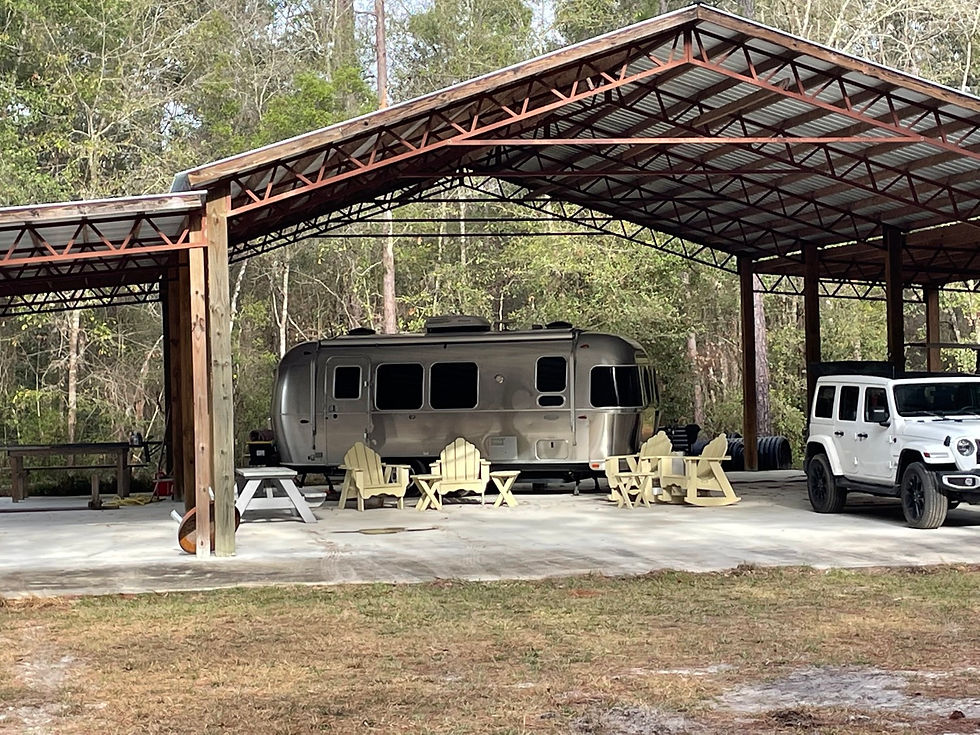
Same setup, different angle. The power plant is in the Jeep, not in a cabinet that does not exist on a small Airstream.
How it behaved overnight
On the property, the 4xe could run the trailer air conditioner all night. Quiet. In the morning, if the pack had sagged, the Jeep would start, put about 10 percent back into the battery, and shut off. Then it was quiet again.
That is why I liked it better than a generator. A generator is honest power. It is also a neighbor you did not invite. This setup used the hybrid pack first and only woke the engine when it had to.
I later used the same Jeep stack on a 2017 Flying Cloud 23FB under that same pole barn. Same idea. Bigger trailer, same tow-vehicle power plant.
What this is not
This is not a rolling generator while you drive. I used it parked.
This is not a substitute for a real house bank in a 33-foot Classic. The Basecamp is small. That is why the Jeep was the right place for the inverter.
This is not a claim that 10-gauge and a 4,000-watt inverter are the only correct sizes for every 4xe. They are what I ran, on my land, with my loads.
The factory DC-DC on a 4xe is not a 4,000-watt pipe. I took power at the 12-volt battery so I was not limited to the small converter rating. That is also why the solenoid and the cable routing mattered.
What I would tell another Basecamp owner
If your trailer is short and you camp off-grid, do not assume the answer is more batteries inside a cabinet that does not exist. Sometimes the answer is the vehicle you already hooked to the tongue. My 4xe plus that inverter let a 16-foot Airstream live on 25 acres with AC and without a generator soundtrack.
The Flying Cloud 23FB proved it was not a one-trailer trick. Same Jeep. Same box. Different shell.
Next chapters are the later rigs, where the work moved inside the Airstream. This one stayed in the Jeep on purpose.
Comments